
How Much Does Mobile Home Removal Cost in Texas?
A national cost guide puts mobile home removal cost at about $2,000 to $6,000 when the home is torn down. That is its average range to demolish a mobile home. Mobile homes cost less to tear down than site-built houses, mainly because they lack a permanent foundation. Where your job lands depends on size, additions, the pad and the haul.
These are market numbers, not our price list. Every mobile home demolition we price gets a written estimate after we look at the site. Hauling a home away in one piece is a different job, covered below. So is the Texas paperwork that follows a teardown.
What does it cost to tear down a single wide or a double wide?
That national range covers mobile homes as a group and is not split by width. Other cost guides split it, and their numbers run higher. One puts a single wide at $3,000 to $8,000 and a double wide at $5,000 to $15,000. That includes demolition and debris disposal. A demolition industry guide puts the averages lower. It says $3,000 to $5,000 for a single wide and $5,000 to $8,000 for a double wide. A double wide is two sections joined on site, with more roof, floor and frame to take apart and haul.
| What you are paying for | Published range | Notes |
|---|---|---|
| Tearing down a mobile home | $2,000 to $6,000 | Average range, not split by single or double wide |
| Single wide, demolition and disposal | $3,000 to $8,000 | Another guide’s average: $3,000 to $5,000 |
| Double wide, demolition and disposal | $5,000 to $15,000 | Another guide’s average: $5,000 to $8,000 |
| Debris haul-off | $400 to $800 per truckload | To a landfill or a recycling center |
| Concrete pad removal, no steel | $2 to $4 per sq ft | Unreinforced concrete |
| Concrete pad removal, with rebar | $4 to $6 per sq ft | Reinforced concrete |
Those ranges come from published cost guides. Ask whether a bid includes the haul. One guide notes that some smaller demolition companies leave removal out and charge a fee to bring in a hauler.
What drives the price of mobile home removal?
Size comes first. A double wide or a triple wide has more of everything than a single wide. Additions come next. Porches, decks, carports and room additions each come down and leave on a truck. Skirting, steps and ramps come out too.
The steel frame sits under the floor, and some homes still have their axles. Steel is heavy and does not break up like the walls and the roof. The home also sits on piers, with straps tied to ground anchors. Those come out so the next build starts on clean ground.
Utilities come before any machine. Power, water, sewer and gas get shut off and disconnected first. Cost guides list that step ahead of any demolition.
Access matters as well. The excavator and the dump trucks need room to work. A home behind a narrow gate, under big trees or on soft ground takes longer. Each truckload costs drive time and a fee at the landfill. If you suspect asbestos in an older home, one national guide says to start with inspection and testing, about $500.
Permits depend on where the home sits. For a home inside San Antonio, start with our guide to the San Antonio demolition permit. Outside the city, ask the city or county office where the home sits what it needs.
What happens to the pad, the piers and the septic system?
Some mobile homes sit on a concrete slab or concrete runners. When that concrete has to go, it is priced as concrete removal. One national guide puts that at $2 to $4 a square foot without steel and $4 to $6 with rebar.
After the home is gone, the piers and anchors come out and the holes get filled. That leaves the ground ready for grading.
Septic is a separate trade. In Texas, a TCEQ-licensed installer sets and permits a septic system. If a new home will use the old tank and drain field, talk to one before it goes in. Mark the tank and the field before demolition day so no truck drives over them.
What paperwork does Texas require after a mobile home is torn down?
Under the Texas Occupations Code, a manufactured home is salvaged if it is scrapped, dismantled or destroyed. The owner of a used home that is salvaged must then apply for a new statement of ownership. That statement shows the home is salvaged. The application goes to the Texas Department of Housing and Community Affairs (TDHCA).
Two more rules matter. A salvaged home may be sold only to a retailer licensed by the state. A recorded tax lien can be released by filing a tax certificate or a tax paid receipt with TDHCA.
This is general education, not legal advice. Before a home is scrapped, call TDHCA’s Manufactured Housing Division or talk to a lawyer.
What if the mobile home on your land belongs to someone else?
Sometimes the home on the land is not the landowner’s. Texas law gives the landowner a path, but it takes time. The home must have sat unoccupied for at least four months. The lease or debt tied to it must also be delinquent.
First, the landowner sends a notice of intent to declare the home abandoned. It goes by mail, return receipt requested, to the record owner, the lienholders and the tax collector. If the home is still on the land 45 days after the notice is postmarked, the liens are extinguished. The landowner may then apply for a statement of ownership in their own name.
Do not tear down a home you do not own until that paperwork is done. The law has more detail than this summary, so check with TDHCA’s Manufactured Housing Division or a lawyer first.
Should you tear down a mobile home or haul it away whole?
Moving a home in one piece is a job for a mobile home mover, with its own quote. It suits a home that is sound and has a buyer or a lot waiting. Set the mover’s quote next to a teardown quote before you decide.
A teardown suits a home that is storm damaged, fire damaged or worn out. It also suits a lot being cleared for a new build. Once a home is scrapped or dismantled, Texas treats it as salvaged, so plan the paperwork with the teardown. For a site-built house on the same land, see what house demolition costs in Texas.
What happens after the mobile home is gone?
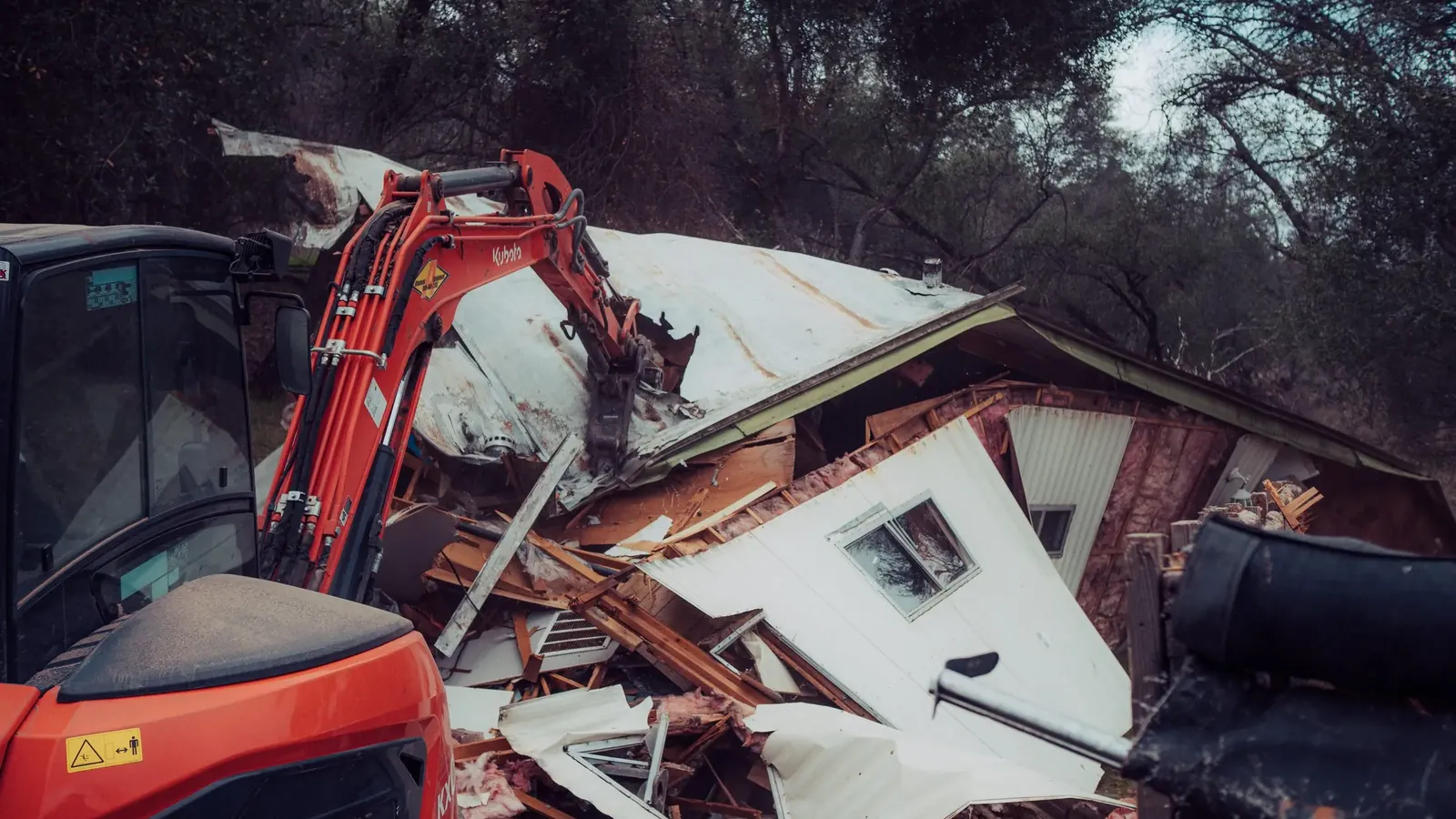
The excavator takes the home apart, and the debris leaves by dump truck hauling. Then the lot is graded so it drains and is ready for what comes next. Global Contractors LLC has done excavation and demolition since 2006.
We are based at our yard in Pleasanton, south of San Antonio. We work across San Antonio and about 50 miles around the city. See how our house demolition work handles mobile homes, houses, garages and barns. Call (253) 606-9497 for a free estimate.